
We analyzed 40+ reviews & seller discussions to understand why sellers leave Rithum (ChannelAdvisor)
.png)
Key takeaways
- The reasons sellers evaluate alternatives to Rithum (ChannelAdvisor) are usually tied to business changes. As teams grow, priorities shift, workflows evolve, and platform requirements change.
- Operational effort came up repeatedly throughout the research. Sellers frequently discussed onboarding, training, maintenance, troubleshooting, and the resources required to keep the platform running smoothly.
- Flexibility matters. Many sellers were looking for software that felt easier to manage, easier to support internally, and easier to align with the way their business operates today.
- Plenty of sellers had positive things to say about Rithum. Reviews often included praise for the platform's capabilities alongside concerns about pricing, support, or day-to-day usability.
If you're evaluating multichannel ecommerce platforms, you've probably come across ChannelAdvisor, now part of Rithum.
Over the last few years, we've had conversations with an increasing number of brands and retailers evaluating alternatives to Rithum. We wanted to understand whether those conversations reflected a broader trend. To find out, we analyzed more than 40 reviews across G2, Capterra, and Trustpilot, along with discussions from ecommerce professionals on Reddit.
One pattern kept showing up: Sellers who described Rithum as powerful, feature-rich, and capable of supporting complex operations often raised concerns about pricing, support, implementation, or day-to-day usability in the same review.
Pricing, complexity, support, and flexibility appeared throughout the reviews and discussions. Those themes surfaced far more often than requests for additional features.
Here are the five themes that appeared most often.
What sellers value about Rithum
The reviews were surprisingly consistent about what sellers liked. Sellers frequently praised:
- Broad marketplace connectivity
- Strong feed and catalog management
- Automation capabilities
- Centralized multichannel operations
- Enterprise-grade functionality
- Long-standing marketplace expertise
Those strengths appeared across positive reviews, mixed reviews, and even reviews that were ultimately critical of the platform.
1. Cost eventually becomes hard to justify
Pricing came up more than any other topic. Reviewers frequently mentioned platform fees, implementation costs, and overall total cost of ownership. Reddit discussions added another layer, with sellers comparing Rithum to lower-cost alternatives and questioning pricing structures tied to order volume.
Several sellers described reevaluating the return they were getting from the platform. One reviewer wrote: "The cost starts to drain you after a few months, and you start to question yourself for getting into a 2-year contract."

One Reddit user said they were looking for "a cheaper alternative" and wanted to move away from a yearly contract. Another described fees increasing significantly as their business grew. “It [Rithum] works but the cost buildup is brutal if you’re scaling across marketplace.”
The conversation wasn't always about whether Rithum was expensive. Sellers were often comparing the investment against the value they felt they were receiving. For some sellers, pricing became the initial reason they began evaluating alternatives.
2. The platform can be difficult to learn and manage
Many reviewers described a steep learning curve and an interface that takes time to master. “ChannelAdvisor is a very powerful platform but has a fairly steep path to learning all you can do.”

Several mentioned needing significant training before new team members could become productive. “The interface can feel VERY dated and not especially intuitive, particularly for new users.” Others described routine tasks as more complicated than expected.
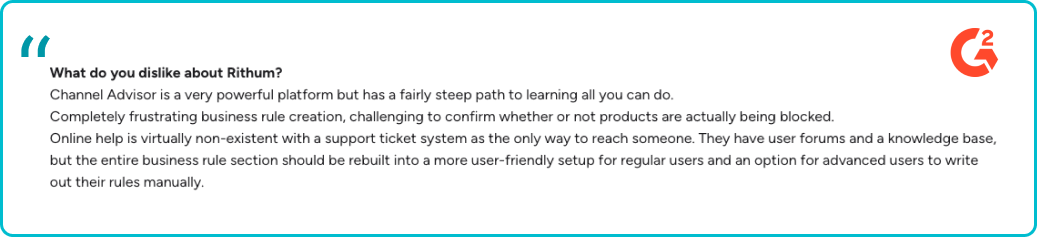
A few reviewers mentioned needing specialized knowledge to manage feeds, troubleshoot issues, or make configuration changes. On Reddit, sellers looking for alternatives frequently mentioned wanting something simpler to implement, easier to maintain, and less dependent on specialized expertise.
"We sold furniture, lighting, and cookware across Wayfair, Amazon, Target, Walmart, TikTok, and eBay, and ChannelAdvisor started becoming more painful than helpful as our SKU count and order volume grew. Too many workarounds and too much manual cleanup."
Complexity carries a cost. Teams spend time on training, maintenance, troubleshooting, and platform management.
3. Support doesn't always meet expectations
Support was one of the most consistent things that came up across the review data. Users frequently mentioned slow response times, difficulty getting timely answers, and inconsistent support experiences. One Reddit commenter put it this way: "ChannelAdvisor’s software is fantastic, but human services have been sub par."
Several reviewers felt that support response times and issue resolution didn't match their expectations for an enterprise platform. When a platform sits at the center of marketplace operations, support quality matters. Listing issues, inventory discrepancies, and order problems can have an immediate impact on revenue.
4. Contracts and long-term commitments create friction
Contract flexibility came up more often in Reddit discussions than review sites. Sellers comparing alternatives frequently mentioned contract terms alongside pricing. Some were looking for month-to-month options. Others wanted to avoid long-term commitments while evaluating new technology or adjusting their ecommerce strategy.
One seller described being offered either a rate increase or a longer contract term with higher overage fees after their business experienced a downturn. “When I told them my business had taken a hit, the options were a 4% increase on my previous rate or a 2-year contract that was cheaper per month but came with higher overage fees.”
Contract concerns often appeared alongside pricing questions, support frustrations, and operational challenges. They were often part of a broader conversation about whether the platform still fit the business.
5. Sellers are looking for more flexibility
Many sellers were searching for software that felt easier to buy, easier to implement, easier to manage, and easier to adapt as their business changed. “Onboarding new brand partners takes forever, and the platform feels heavier than what we actually need to operate.”
That flexibility showed up in different ways throughout the reviews and discussions:
- Simpler workflows
- Faster onboarding
- More transparent pricing
- More responsive support
- Less operational overhead
Many sellers appeared to be reassessing what they actually needed from a multichannel ecommerce platform. One Reddit user said this: “Onboarding new brand partners takes forever, and the platform feels heavier than what we actually need to operate.” As ecommerce operations evolve, platform requirements evolve with them. Several discussions centered on finding software that aligned more closely with current business needs rather than adding more functionality.
Thinking about moving off Rithum?
If you're evaluating alternatives, start by mapping the workflows your team relies on most:
- Marketplace listings
- Inventory synchronization
- Order management
- Feed management
- Reporting
- Integrations
- Automation rules
The more clearly you understand those requirements, the easier it becomes to evaluate whether another platform is actually a better fit. We've helped many brands make the transition from Rithum, and one thing we've learned is that preparation matters more than platform selection.
That's why we created a Rithum migration checklist. It covers the key workflows, integrations, and operational considerations sellers should review before making a switch. If you're in the early stages of evaluating alternatives, download the checklist and use it to assess your current setup.
If you're evaluating Rithum alternatives and looking for a simpler way to manage multichannel ecommerce, we'd love to talk. Connect with our team for a free consultation and see how other brands have successfully transitioned from Rithum to Zentail.
Frequently asked questions
Why do sellers leave Rithum?
Many sellers reevaluate Rithum when their business changes. New channels, larger catalogs, evolving workflows, shifting budgets, and changing support requirements can all influence the decision to explore alternatives.
What are the most common complaints about Rithum?
Common complaints include a steep learning curve, lengthy implementations, pricing concerns, slow support response times, and the amount of effort required to manage the platform. At the same time, many reviewers described Rithum as powerful and capable of supporting complex multichannel operations.
What should I consider before moving off Rithum?
Start by documenting the workflows your business relies on, including marketplace listings, inventory synchronization, order management, integrations, reporting, and automation rules. A successful migration depends on understanding both your current processes and your future requirements.
What are some alternatives to Rithum?
Sellers evaluating alternatives often consider platforms like Zentail, Linnworks, Sellbrite, and other multichannel ecommerce solutions. The right fit depends on your business size, channel mix, operational complexity, and growth goals.
Many brands exploring alternatives to Rithum are looking for simpler operations, faster onboarding, more responsive support, and greater pricing transparency. If you're evaluating your options, it's worth comparing platforms based on the workflows and channels that matter most to your business.