Amazon Cut Product Titles to 75 Characters & Introduced AI Listing Updates
.png)
Amazon has announced one of its biggest product content changes in more than a decade.
As of July 27, 2026, product titles in all categories except media must be 75 characters or fewer. To support the change, Amazon is introducing Item Highlights and AI-generated recommendations to help sellers adapt.
Here's what sellers need to know.
Key takeaways
- Amazon's new 75-character title limit introduces a new AI-powered review process for sellers. Brands will need to review AI-generated recommendations and decide how product information should be distributed between titles and Item Highlights.
- Item Highlights is a new field that gives sellers an additional searchable place to communicate product details. The next big question is whether keywords placed in Item Highlights will carry the same search value as keywords placed in titles.
- Amazon's title update could create a significant operational challenge for brands with large catalogs. Reviewing and approving AI-generated changes across hundreds or thousands of listings may require far more effort than simply shortening product titles.
What changed
Product titles in all categories except media must be 75 characters or fewer.
To support the shorter title format, Amazon is introduced Item Highlights, a new searchable field that provides an additional 125 characters for product details such as materials, age ranges, compatibility information, and use cases.
Amazon is also rolled out AI-powered tools that automatically generate compliant titles and Item Highlights based on a product's existing content.
Sellers could continue using their current titles until July 27. After that date, titles that exceed the new limit will gradually be updated using Amazon's AI recommendations. Sellers will have 14 days to review, modify, or approve the recommendations through the Review Listing Changes tool. If no action is taken, Amazon will automatically apply its recommendations as part of the rollout. Throughout the entire process, all listings will remain active.
How sellers are reacting
The seller response so far has been focused less on the 75-character limit itself and more on Amazon’s use of AI to generate and enforce listing changes. One common concern is whether AI-generated recommendations will accurately represent products. Several sellers shared examples where they felt important details were removed or titles became too generic. One seller put it well: “I’m not against AI, but talk about a nightmare scenario.”
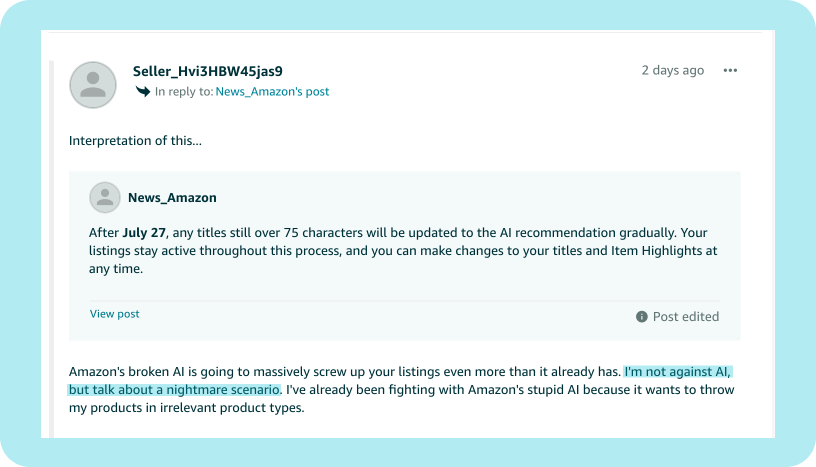
A related concern that showed up was whether shorter, AI-generated titles will make products harder to distinguish from one another. One seller reviewing Amazon’s recommendations wrote: “The AI wants to make all of my listings generic non descriptive titles all exactly the same word for word that does not even tell what my actual product is. If every title the AI generates is exactly the same then none of my products will ever be seen.”
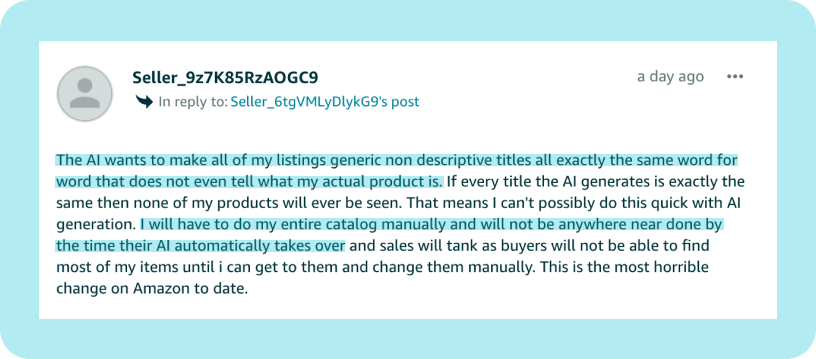
Others question how realistic it would be to review large volumes of AI-generated recommendations, particularly for brands with thousands of listings or products with many variations. One seller wrote: “I have a lot of listings and will not be able to manually complete this in the time we have until Amazon does it itself. That will kill my listings.”
At the same time, not every seller is opposed to the change. Some reported positive experiences with Amazon's title enhancement tools. According to one seller: “The AI tool is actually not bad.”
Source: Amazon Seller Central announcement thread and follow-up discussion threads.
Why Amazon is making the change
Amazon says the update is designed to create a more consistent shopping experience across devices. According to the company, shorter titles are more likely to display completely on mobile screens, helping shoppers understand products more quickly without scrolling through truncated text.
Amazon has also clarified that title visibility has always varied based on factors such as screen size and font settings. The 75-character limit is intended to maximize the likelihood that titles display fully across Amazon's shopping experiences.
To help sellers fit within the new limit, Amazon recommends hacks like:
- Using numerals instead of spelling out numbers
- Using standard measurement abbreviations
- Moving supporting product information into Item Highlights
One detail sellers should keep in mind: brand names count toward the 75-character limit.
Item Highlights introduce a new searchable field
One of the more important details in Amazon's announcement is that Item Highlights are searchable. According to Amazon, Item Highlights are indexed for search and displayed alongside product titles in both search results and product detail pages.
The biggest unanswered question is whether keywords placed in Item Highlights will carry the same search value as keywords traditionally placed in titles. Amazon has confirmed that Item Highlights are searchable, but sellers will likely spend the coming months testing how the new structure impacts discoverability and ranking performance.
What sellers need to do now
For sellers with a handful of products, adapting to the new requirements may be relatively straightforward. For larger catalogs, the amount of work could be significant.
Many brands will need to review hundreds (or even thousands) of listings to determine which information belongs in the title and which details should move into Item Highlights. Amazon has already released updated spreadsheet templates that include the new Item Highlights field, allowing sellers to update the appropriate fields.
AI-generated recommendations may reduce some of the manual work, but they also create a new review process. Sellers should begin identifying which information belongs in titles versus Item Highlights and prioritize reviewing AI-generated recommendations before they're implemented.
For a full channel-by-channel breakdown of title, bullet point, and description requirements (updated for the 75-character limit), see our Ecommerce Titles, Descriptions & More guide.
Sellers remain responsible for AI-generated content
One question that surfaced in Seller Central discussions was what happens if an AI-generated title or Item Highlight creates a compliance issue. Amazon's answer: sellers remain responsible for their listings.
If an AI-generated recommendation results in a policy violation, sellers would need to appeal through the standard Seller Performance process. Brand owners will have 14 days to review, modify, or approve recommendations before implementation. That means reviewing AI-generated content may become just as important as creating content manually.
Other details sellers should know
- The update applies to bundles. Bundle titles and Item Highlights can be provided directly or populated from individual product pages.
- The 75-character limit applies to both parent and child variation titles.
- Item Highlights and Bullet Points are separate attributes.
- Item Highlights are optional and are primarily monitored for restricted content.
Frequently asked questions
When does Amazon's 75-character title limit take effect?
Amazon's new title requirements take effect on July 27, 2026, for all categories except media.
What happens if my Amazon title is longer than 75 characters?
Amazon will generate a recommended title and Item Highlights for listings that exceed the new limit. Sellers will have an opportunity to review, modify, or approve those recommendations before they are implemented.
Will Amazon automatically update my product titles?
Yes. According to Amazon, titles that exceed the new limit will gradually be updated using AI-generated recommendations. Sellers will have a review period before the recommendations are applied.
What are Amazon Item Highlights?
Item Highlights are a new product attribute that provides an additional 125 characters for product details such as materials, age ranges, compatibility information, and use cases. Amazon has confirmed that Item Highlights are indexed for search and displayed alongside product titles in search results and on product detail pages.
Does the 75-character limit include the brand name?
Yes. Amazon has confirmed that the brand name counts toward the 75-character limit.